



05 Oct South Africa’s First Cars
South Africa was introduced to the horseless carriage 10 years after the Benz Velo… Mike Monk describes the event…
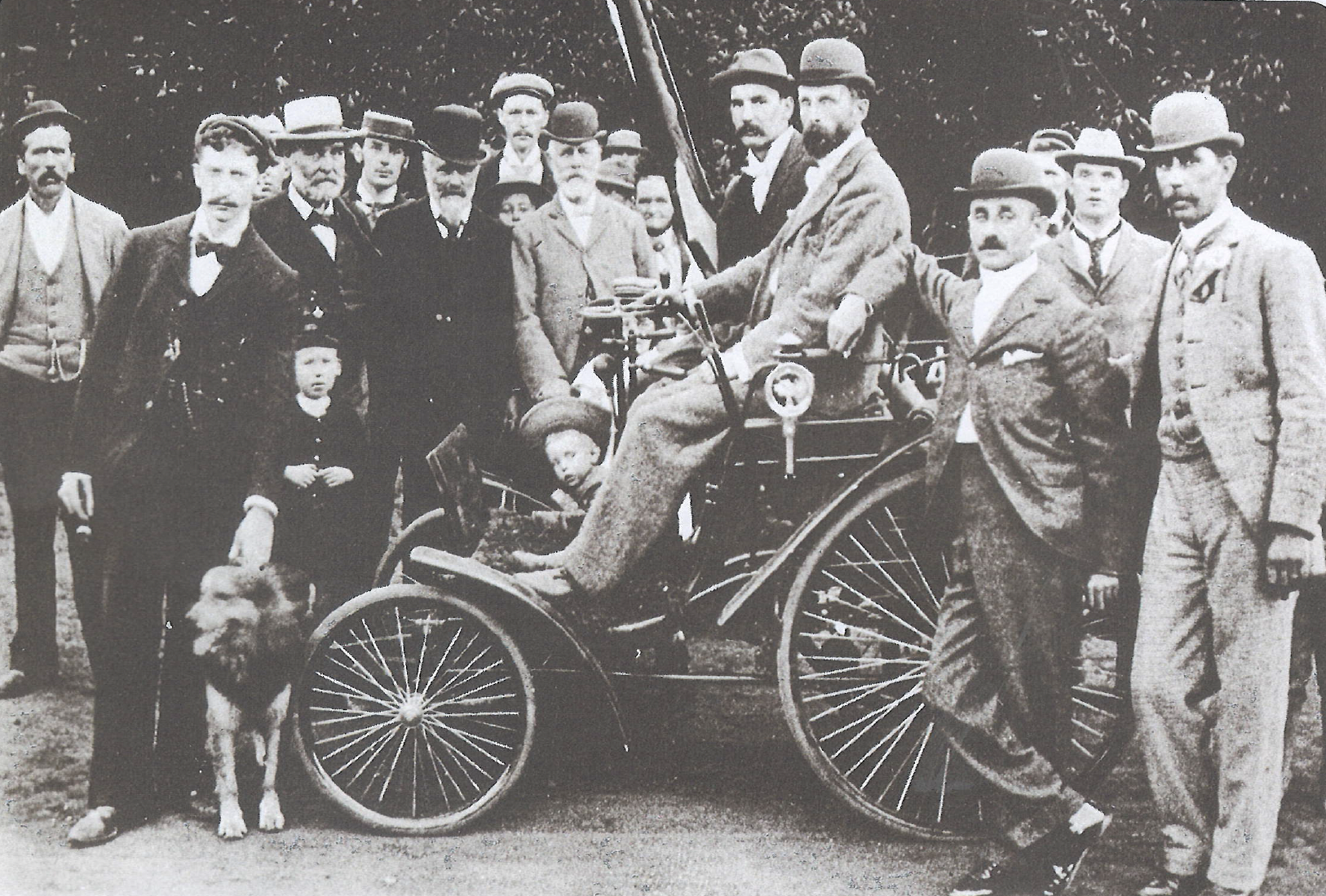
The very first car to arrive in South Africa was a Benz. The company’s production ledger for July to August 1896 shows vehicle number 383 – a Velo – was dispatched to ‘Capland’ on July 25, 1896. The car was shipped aboard the steamship Herzog. The Standard and Digger’s News of 22 December 1896 reported the car had landed in Port Elizabeth and was railed to Pretoria. The reason why it took five months to reach South Africa is not known, although The South African Mining Journal of 2 January 1897 suggested the delay had been caused “… by the stupidity of the Hamburg forwarding agent…” Whatever the reason, it was almost certainly to have been the first motor car to appear in the southern hemisphere.
The Velo was ordered by Pretoria entrepreneur John Percy Hess and A E Reno, one of the founders of the Pretoria News. It was presented to the South African Republic as ‘The Invention of the Age’ at Pretoria’s Berea Park on 4 January 1897 in the presence of the State President, Paul Kruger. On 13 January it made a further appearance at The Wanderers in Johannesburg, billed as ‘The Rage and Topic of all Europe’. At the time of the Benz reaching SA, it was reported that only 720 vehicles were privately owned and operated in the civilised world.
The car was sold to Pritchard Street coffee merchant Albert H Jacob who used it extensively to market his wares. (Incidentally, Albert’s surname is often quoted as Jacobs and there is even a picture of his business with the name above the door spelt as Jacobs, but in 1997 at the centennial celebration of the Berea Park unveiling, a descendant of his advised that the name is without the ‘s’.) However, six years later the car, nicknamed The Coffee Pot, was destroyed in a warehouse fire, reportedly at Jacob’s premises.
SA’s evolution with the horseless carriage really took off when Wilhelm Schmitt was involved in the shipment of the first vehicles to Cape Town. Wilhelm was apprenticed to motor pioneer Carl Friedrich Michael Vaillant Benz, who in 1883 had established Benz & Cie Rheinische Gasmotoren-Fabrik in Mannheim, Germany. Wilhelm became responsible for body fitment, and in some instances was sent with the vehicles to customers, including those overseas.
When Levi Mole of electrical engineering company Koenig and Sons, whose offices were in the Opera House building in Darling Street, Cape Town, ordered three vehicles from Germany – a 15 hp Benz Ideal, and two Daimler Wagonettes (charabancs) – Wilhelm was sent out with the shipment aboard the Union Line mail ship Moor, which arrived in Cape Town on 2 February 1898. What is slightly baffling is that that the ship sailed from Southampton, so Wilhelm must have first taken the Benz from Germany to England, where the Daimlers were manufactured (in Coventry) – the companies had not yet merged. Whether Wilhelm was responsible for all three vehicles is unknown.
While the Benz was likely the personal transport of Mole, the two charabancs provided SA’s first bus services: one route was from the Standard Bank in Adderley Street along Dock Road to the harbour, and in the March 1899 edition of The Cape Argus included the first published photo (of the charabanc in Dock Road) of a motor car in the Cape. The other route was Sea Point’s tramway terminus along Victoria Road to Camps Bay.
The rest, as the saying goes, is history. Wilhelm returned to Cape Town in 1902 and settled in Philippi, which at the time was home to many German immigrants. He established the Motor Engineering Works in Rutger Street in Cape Town in 1905 and from these premises he serviced and sold Benz and, shortly afterwards, Ford motor cars. Schmitt’s engineering business continued to flourish through later generations.