


01 Sep Power to the People
While celebrating the early years of Mercedes-Benz, for a bit of fun here is a model far removed from Gottlieb Daimler’s motorised carriage and illustrates what five decades of development can produce…
In the mid-1970s, Mercedes-Benzes were generally considered to be rather posh, rather expensive and rather sedate. The top-line S-Class was a benchmark in mass-produced automotive luxury and often used by dignitaries around the world. But typical of the evolution of the motor car, someone always wants to go faster, and while a fledgling tuning house called AMG looked to racing, M-B engineer Erich Waxenberger put the company’s powerful 6,3-litre M100 V8 (as used in the luxurious 600 limousine) into a W109-series 300SEL body. Surprisingly perhaps, conservative M-B liked the concept and launched the car at the Geneva Motor Show in March 1968, and at the time of its release it was the world’s fastest four-door car. Built until 1972, some 6 500 were sold…
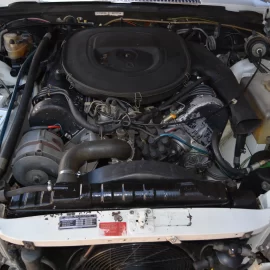
In 1972 the W116-series S-Class was introduced and buoyed by the success of the 300SEL 6,3, at the 1974 Geneva Motor Show launched a 6,9-litre version of the long-wheelbase 450SEL as the flagship model of the range. The 6 834-cc engine was a cast-iron V8 with an aluminium cylinder head housing a single overhead camshaft per bank operating sodium-filled valves with hydraulic lifters. Fuel was supplied by Bosch K-Jetronic electro-mechanical injection and the motor’s peak outputs were 210 kW at 4 250 r/min and 549 N.m of torque at 3 000. Dry-sump lubrication was employed. Each hand-built unit was bench-tested for 265 minutes, 40 of which were under full load.
Taking drive to the rear wheels was a W3B 050 three-speed auto transmission unique to the 6,9, and a ZF limited-slip differential was standard. Final drive was a high 2,65:1 for relaxed cruising. Road test figures of the time realised a top speed of 237 km/h and a 0-100 km/h time of 7,8 seconds. Fuel consumption was given as 16,2 ℓ/100 km freeway and 23,2 ℓ/100 km urban.
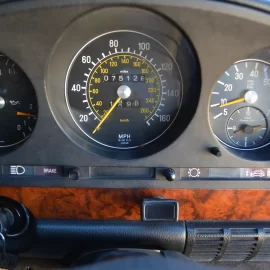
Production began in limited numbers in 1975 and, then as now, Mercedes-Benz used the S-Class to introduce some new technology into its armoury. In this case it was hydropneumatic self-levelling suspension, unlike the 600 and 300SEL 6,3 that used air suspension. Similar to the Citroën system, the benefits were said to be more progressive springing. The more the enclosed air in the suspension is compressed, the more difficult it is to compress, thus the suspension rate changes in proportion to the load. Instead of conventional shock absorbers and springs, the system used a combination of fluid-filled struts and nitrogen-filled accumulators, and was pressurised by a hydraulic pump driven by the engine’s timing chain. Ride height could be altered by a facia-mounted knob under the speedometer that raised the car an additional 50 mm for increased ground clearance. The 6,9 was shipped with hard rubber emergency dampers that served as temporary springs, which allowed the car to be driven in the event of a hydraulic failure.
In addition to the self-levelling suspension, in 1968 the 6,9 was offered with (optional) electronically-controlled anti-lock four-wheel disc brakes, one of the first cars to feature this ground-breaking Bosch development.
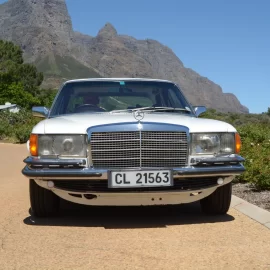
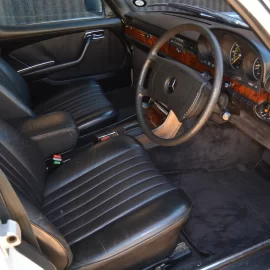
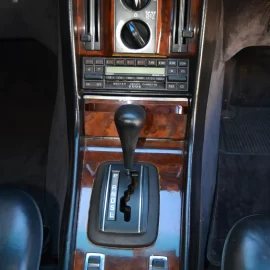
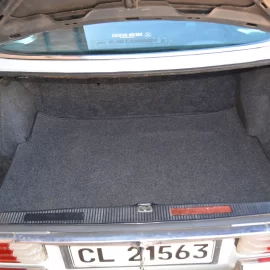
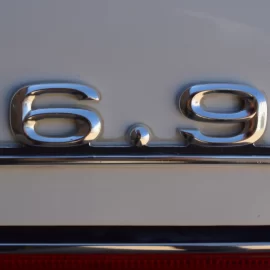
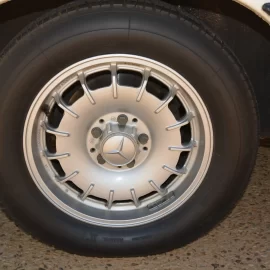
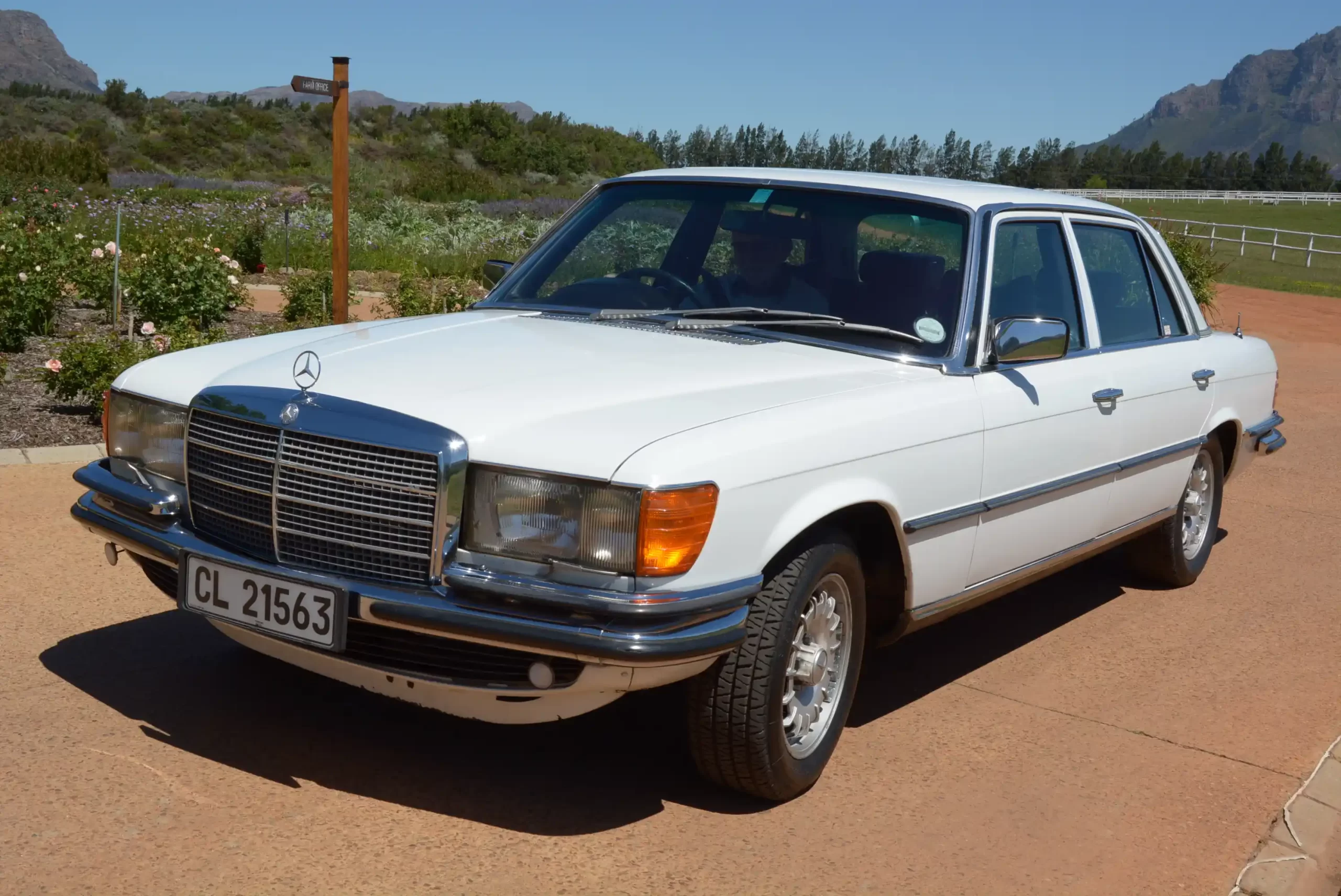
But despite the monster V8 under the bonnet, this is no testosterone-driven overgrown muscle car. Far from it, in fact. Apart from the (delete option) 6,9 badge on the boot lid and slightly bigger wheels than standard, this car is indistinguishable from any other W116 S-Class. This is a Q-car limousine. Inside, there is nothing extra special either; there are electric windows, but seats and exterior mirrors have to be adjusted by hand. However, a clever Chrysler-developed climate control system did add a touch a luxury, and the facia was a classy burled walnut veneer.
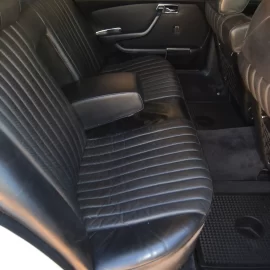
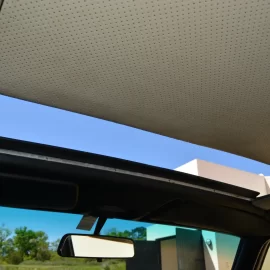
Approaching FMM’s 1980 example, the overriding understatement is readily apparent. It looks like any other period white S-Class. Inside, the feeling is the same. Switch on, pull the knob and wait for the near 2 000 kg body to rise to the occasion. Start up and the V8 slips into operation with little more than a murmur. Pull the shifter into D and drive away. Totally effortless, a car designed to eat up kilometres with minimum fuss. The seats are comfortable in that 1970s ‘hard but supportive’ style, and with its long-wheelbase (2 960 mm) there is plenty of room. Slender pillars and a deep glasshouse allow plenty of light to infiltrate the cabin, and it is easy to imagine tackling any long distance without any qualms. An electric sunroof is available to provide a touch of al fresco.
Maximum engine revs are 5 300, but with so much low-down torque there is no need to reach for the red line. The suspension is superb, providing a ride that is cushioned without being soft. And body roll is not an issue. But do not think of the 6,9 purely as a boulevardier: one featured prominently in a high-speed car chase in the film Ronin. And almost certainly a 6,9 with a camera mounted on the front bumper was the actual car used by Claude Lelouche in his high-speed drive through Paris in his 1976 movie C’était un rendezvous. The Ferrari 275 GTB soundtrack was added afterwards…
Since 2005, AMG has been a subsidiary of Mercedes-Benz, and the coalition thrives as the performance wing of the Stuttgart manufacturer. With the 450SEL 6,9, a case of from mighty beginnings even bigger things do grow…