


01 Sep Ponton: Mercedes’ Smooth – and Safe – Operator
There have been a number of landmark models in Mercedes-Benz’s production history, one of which was the Ponton…
The Mercedes-Benz Ponton is a family of luxury sedans, coupes and convertibles built by Daimler-Benz from 1953 to 1962. Named after the German word for ‘pontoon’ due to its smooth, slab-sided body style that merged the fenders and body into one shape, although, at the time, the company did not refer to any of its cars using a nickname.
In the early 1950s, Mercedes-Benz model offerings comprised of the expensive W186 300 Adenauer and exclusive 300 S sports tourers at the top end of the scale, along with the pre-war designed W136 170 for the masses. Seeking to expand its production, Mercedes turned toward the unibody concept to design a line of mass-produced cars. Work began in earnest on the Ponton-bodied cars in 1951, with a design focused on passenger comfort and safety. Head of the design team was Dr Fritz Nallinger with styling headed by Karl Wilfert. Also, in the design team was Béla Barényi, who conceived the passive safety (crash protection) engineering of the body.
Code-named W120 180, the Ponton became the base for a diversified series of models incorporating bigger engines and different wheelbases/body sizes. The first to go into production was the 1953 1,8 litre four-cylinder, four-door sedan, available as the 180 petrol and the 180D diesel. In 1954 the 220a was added, developed mostly by stretching the W120’s body by 170 mm and fitting the longer 2,2-litre straight-six M180 engine, complemented by a new rear suspension. In 1956, the six-cylinder model was expanded into an entire range. The 220a gained a second carburettor and was upgraded to become the 220S, shortly joined in the line by new, distinctively bodied, shorter wheelbase two-door coupe and convertible models. A third saloon series, the W105 219 was created by grafting the six-cylinder nose onto the shorter body of the four-cylinder aft of the firewall.
In 1956, the four-cylinder model received an all-new, short-stroke 1,9-litre petrol engine option, the W121 model 190, joined in 1958 by a 1,9-litre diesel. In 1958, the 220S models were upgraded with fuel injection, and became the W128 220 SE series. The models 180D and 190D received further updates in 1959 and 1961. A shortened floorpan of the four-cylinder sedan was also modified to serve as the structure for the iconic W121 190 SL roadster. Certainly, a case study in model development…
Austrian-Hungarian engineer Béla Barényi originally invented and patented the crumple zone concept in 1937 before he worked for Mercedes-Benz, and in a more developed form in 1952. Barény questioned the prevailing opinion that a safe car had to be rigid. He divided the car body into three sections: the central, rigid, non-deforming passenger compartment, and crumple zones in the front and the rear. They are designed to absorb the energy of an impact (kinetic energy) by deformation during a collision.
The Ponton partially implemented the concepts of crumple zones and the non-deformable passenger cell into its three-box design by having a strong deep platform to form a partial safety cell (patented in 1941). The design concept was proven by ADAC crash test facility in June 2010 when a Ponton was crash-tested in their Technical Centre in Landsberg am Lech, confirming the existence of the design incorporated into the vehicle. This made for a milestone in car design with front and rear crumple zones for absorbing kinetic energy on impact. Barényi’s concept was fully used in the later Mercedes-Benz ‘Fintail’ model.
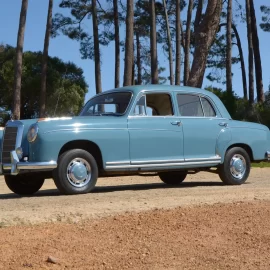
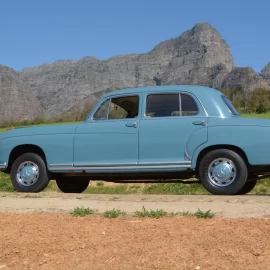
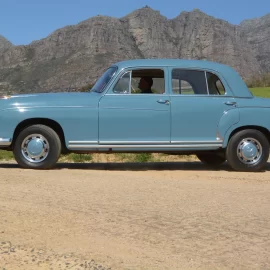
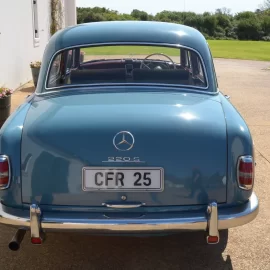
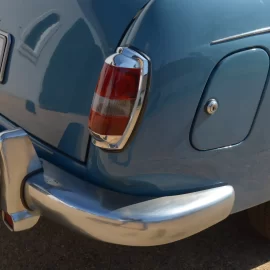
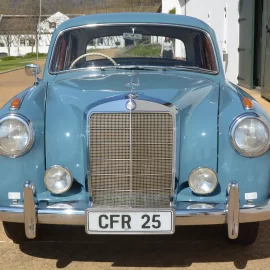
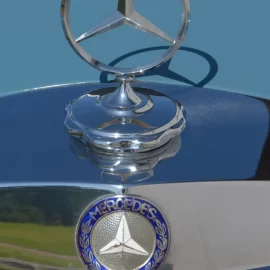
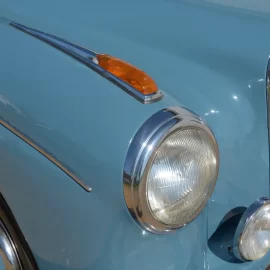
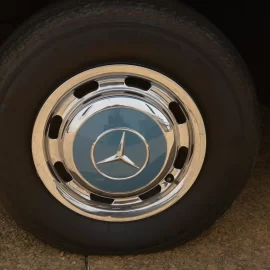
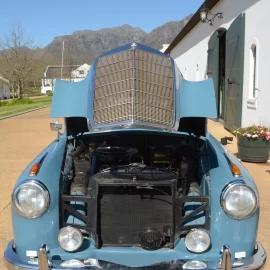
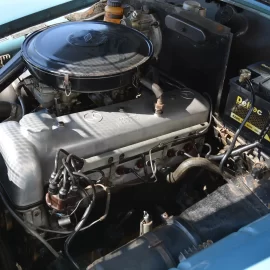
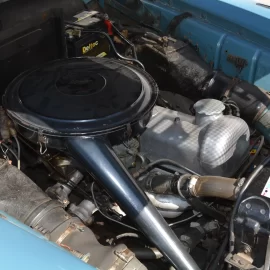
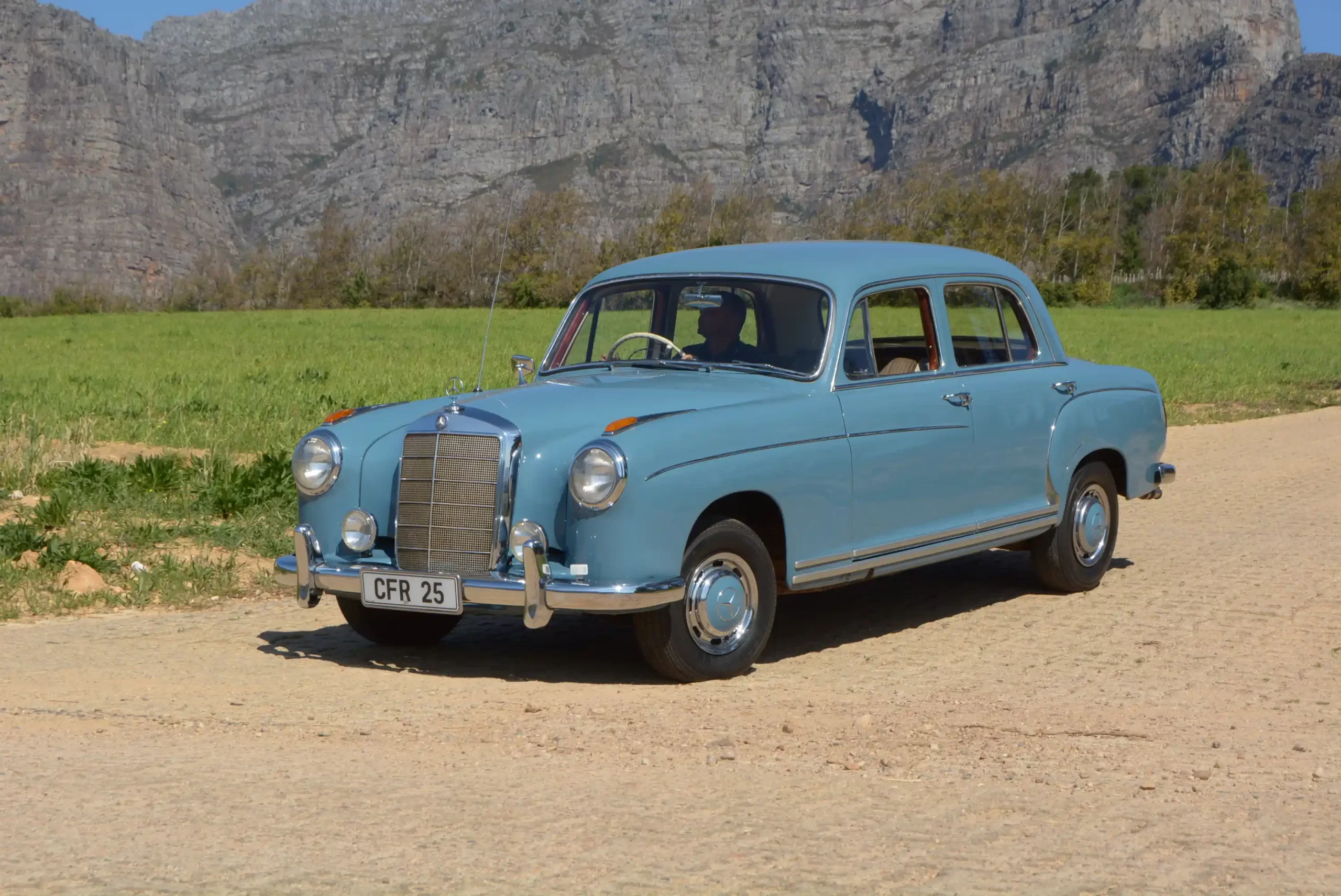
FMM’s Ponton is a 1958 220S that is powered by the single overhead-cam 2 195 cc in-line six that was upgraded in 1957 with twin Solex carburettors that upped power output to 78 kW at 5 200 r/min. Transmission is via a four-speed manual gearbox with a column shift – an automatic was optional – and while the shift action is lengthy, the gears engage easily and the engine proved torquey enough to offer relaxed progress. Top speed was given as 160 km/h.
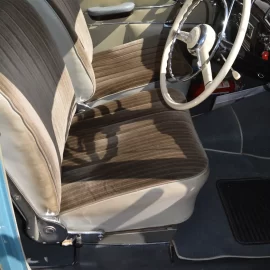
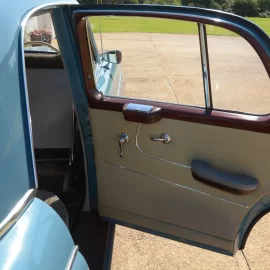
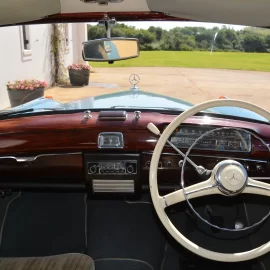
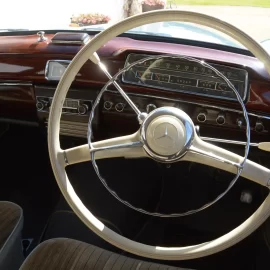
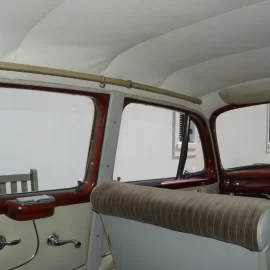
This example is in superb condition, and particularly attractive in its blue paintwork. It’s a spacious sedan with rich, ribbed cloth seat facings. The backrest of the generously sized front seats tip forward. Rear legroom is also plentiful. The facia, door cappings and window frames are a deep-rich wood and chrome handles, fixtures and fittings add an air of quality. Full length roof side rails are unusual. A radio is fitted. Full instrumentation is housed in a rectangular panel and the ivory steering wheel carries a horn ring.
The Ponton is a car that immediately feels comfortable and ‘right’, so little wonder it was a popular model that helped confirm Mercedes-Benzes reputation of being a manufacturer of quality automobiles.