


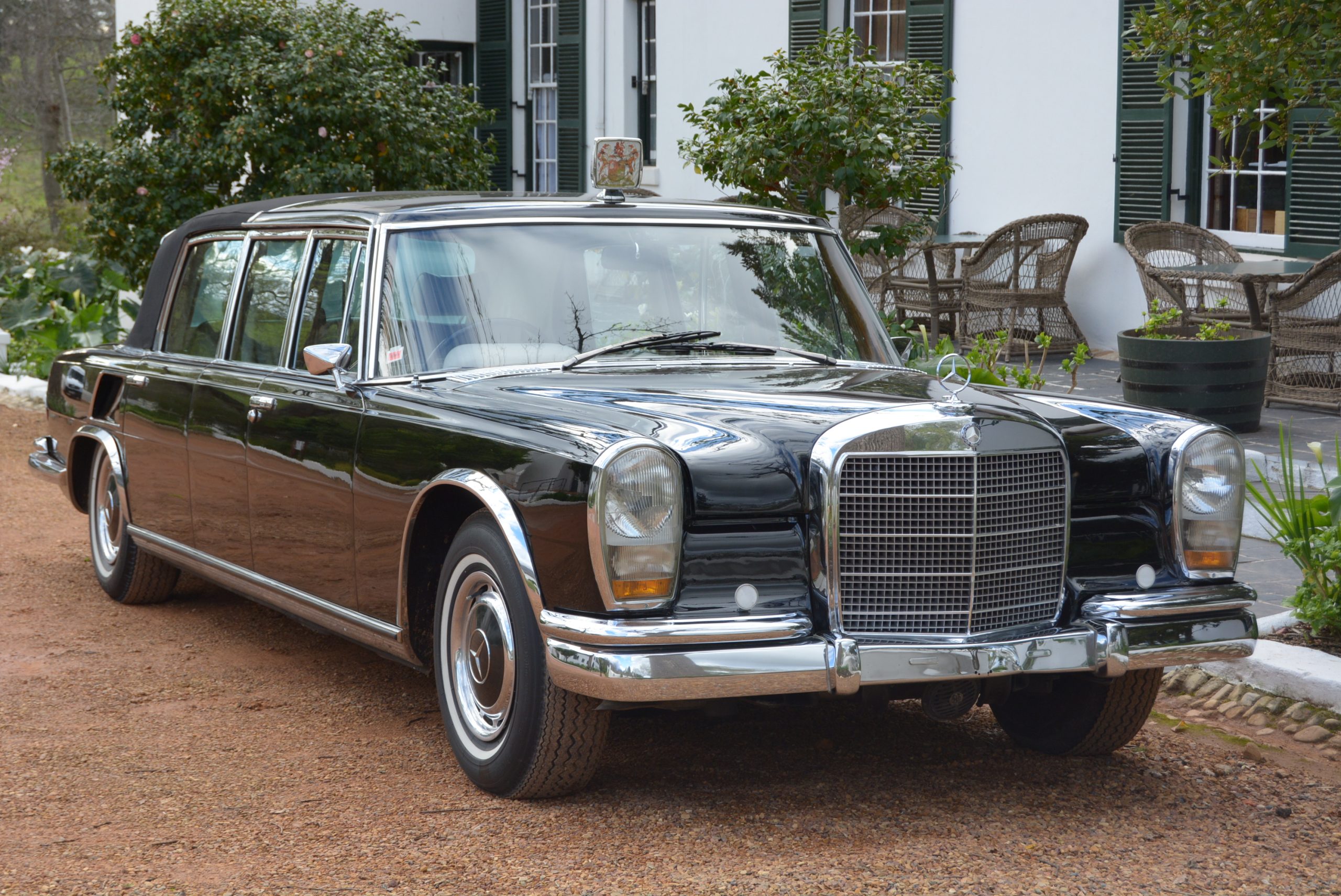
01 Aug Stately At A Stretch
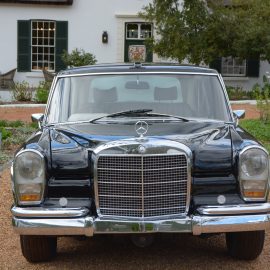
Still on the presidential theme, at least half-a-dozen of South Africa’s leaders have been transported in this rare, right-hand drive Mercedes-Benz 600 that boasts a number of evocative descriptions…
Presence. Anyone in a global limelight needs to have an impressive appearance or bearing that garners respect, be it a papal leader, the head of a country, a movie star, a business mogul or (replace any rose-tinted spectacles with dark glasses) even a drug lord! Travelling in style forms just one aspect of the overall impression, and what is generally referred to as a ‘stretch limo’ is often the preferred mode of transport, although today they are as much about taking regular folk to Matric balls and hen parties. In America, many are used as hotel/airport shuttles in place of customary taxis. But back in the 1960s such vehicles were less commonplace and far more bespoke, and when Mercedes-Benz saw fit to produce something custom-made to offer esteemed clientele, little surprise that a special vehicle would result.
Tagged as a 600, the design of this ‘grosser Mercedes’ is generally credited to Frenchman Paul Bracq, whose career began in the design studio of Philippe Charbonneaux, where in 1953 and 1954 the studio produced the designs for the French presidential limousine built by Citroën. After fulfilling his military service in 1957, Bracq worked for Daimler-Benz as head of the design centre at Sindelfingen for 10 years. Bracq then returned to France and was employed in a number of styling roles that included the TGV high-speed passenger train. From 1970 he worked as design director at BMW for four years followed by a stint with Peugeot, where he was involved in personal transportation for the Pope. Working with famed Daimler-Benz engineers and designers Friedrich Geiger and, latterly, Bruno Sacco, there can be little doubt that the 600 was conceived and developed in good hands.
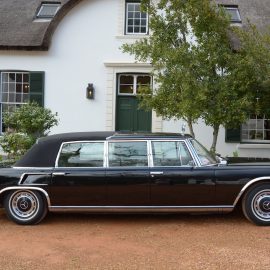
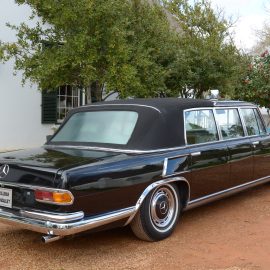
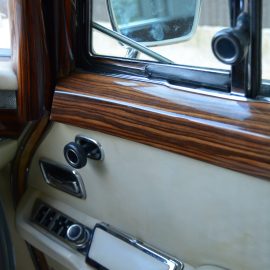
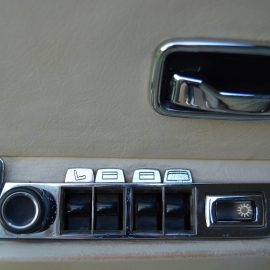
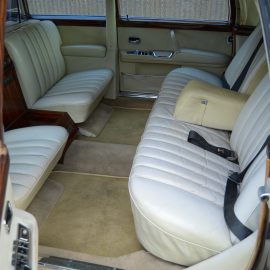
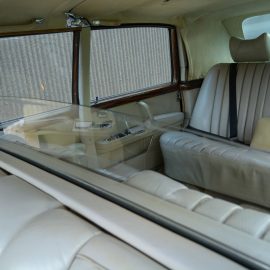
The car was offered in two basic formats, a short-wheelbase (3 200 mm) saloon capable of being owner driven, and a long-wheelbase (3 900 mm) stretched version conceived to be driven by a chauffeur and with the option of a folding rear roof section. Additional body panels between the front and rear doors increased body length from the SWB’s already sizeable 5 450 mm to an even more substantial 6 240 mm. The extra space this afforded allowed for a pair of rearward-facing seats to be incorporated into the rear passenger compartment to create a boardroom-like setting for four – complete with a drinks cabinet. A sliding glass partition behind the front seats afforded some privacy for the dignitaries travelling in the back – it was an option on the SWB – with an intercom provided for communication. A complex engine-driven 150-bar hydraulics system powered the suspension damping, windows, seats, boot lid, automatically-closing doors and folding roof (once sizeable interior latches had been released).
The LWB version was designated a Pullman, a name originally associated with rail travel and denoting a very comfortable carriage for sitting and/or sleeping in that was later occasionally applied to upmarket road transport too, such as luxury coaches. As already mentioned, the LWB was also available as a semi-convertible, in essence a landaulet, the origin of the word meaning a four-wheeled horse-drawn carriage with a top that may be let down or folded back and a raised seat for the driver (a landau) that subsequently became landaulet to describe a car with a convertible top for the back seat while the front seat is either roofed or open.
Production of the car began in 1960 and it was manufactured in limited numbers right up to 1981. Out of a total of 2 678 models produced, the SWB version was by far the most popular with 2 190 units built, and of the 487 LWBs (304 four-door, 124 six-door) only 59 were Landaulets, and only 10 right-hand drive models were built, which makes the example you see here quite a rarity. As a brief aside, the factory also built a 600 coupé as a retirement gift for Dr Rudolf Uhlenhaut, an Anglo-German engineer who worked for Mercedes-Benz from 1931 to 1972 during which time he had a long association with the company’s motor racing programme and is well known for creating the Gullwing Mercedes.
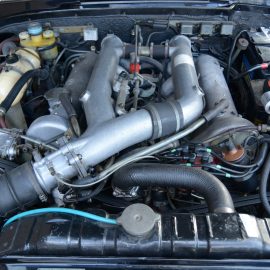
Powering such a big and heavy vehicle – the SWB weighed 2 600 kg, the LWB 2 770 – required a suitably powerful engine and the 600 is propelled by a single-overhead-cam, mechanically fuel-injected 6 332 cc V8 delivering 180 kW at 4 000 r/min and a fairly substantial 500 N.m of torque at 2 800. Driving through a four-speed automatic transmission, the 600 SWB had a top speed of just on 205 km/h – the LWB topped-out around 193 km/h although such velocities were seldom, if ever, approached during duty. Unless running away from terrorists or the law… Fuel consumption was given as 24-26 litres/100km.
However, such cars are more about ride comfort than performance and the 600 boasts adjustable air suspension with double wishbones, rubber springs and a stabilizer bar up front. But whereas lesser Mercedes-Benzes used a service-intensive and wear-prone king-pin setup, the 600 featured front uprights located by ball joints. The rear suspension featured a low-pivot swing axle located by radius arms, also with rubber springs and a stabilizer bar. Brakes are dual-caliper 291 mm discs up front and 294.5 mm discs at the back. Steering is by a power-assisted recirculating ball. Tyres are 9.00H15 whitewall six-ply radials.
Riding in the back the ambience is one of lightness and comfort. By today’s standards the well-padded seats are not particularly cosseting but offer enough support to be able to stretch out and observe the outside world in relaxed surroundings. The air suspension was playing up so any thoughts of a ‘magic carpet ride’ were not possible, but doubtless the system, when functioning properly, would be exceptional in true Pullman tradition. Spacers were provided in the toolkit to support the seats in the event of an hydraulics failure. Loose footrests are provided, and the compartment has its own air-conditioning system.
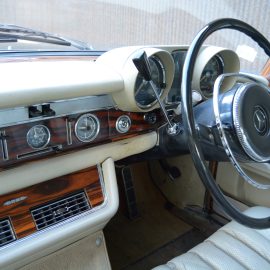
Despite the car’s length, there is not a huge amount of fore/aft space up front but the control layout is straightforward. As any stretch-limo driver will tell you, manoeuvring such a leviathan requires some forethought but with practically everything power assisted – even the air vent in front of the windscreen – once familiarized, the driving experience is not too overwhelming. Neat touches include a footwell-mounted parking brake that releases automatically when the car is put into drive or reverse via the column-mounted shift lever. And two horns, one a regular component, the other a compressed-air monster that bellows like an Oompah band.
Customers of the 600 have included numerous heads of state and religious groups as well as a range of personalities from Elizabeth Taylor to Pablo Escobar. Examples have also appeared on the silver screen, including the Bond movies On Her Majesty’s Secret Service, Diamonds Are Forever and Octopussy, as well as The Witches of Eastwick and the popular TV series Falcon Crest.
This particular 600 was produced at the end of 1970 and was shipped to Cape Town aboard the German cargo vessel Tugelaland, arriving on 20 January 1971 for handing over to the South African Government by UCDD’s Pretoria-based training manager Herbert Cyrolies. (UCDD – United Car and Diesel Distributors – became Mercedes-Benz South Africa in 1984 when Daimler-Benz acquired control of the company.)
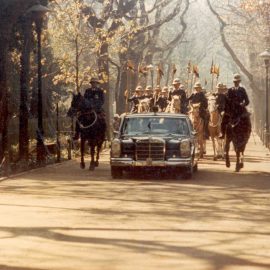
Thereafter the car carried successive presidents Jim Fouché, Dr Nico Diederichs, BJ Vorster, Marais Viljoen and PW Botha. The car was then put into retirement by President FW de Klerk. Apart from its road travel, the 600 clocked up plenty of frequent traveller miles in the presidential Hercules aircraft that regularly flew between Parliament in Cape Town and Waterkloof air base in Pretoria. The car was eventually handed to the South African Cultural Museum (now known as the Iziko Museum). In 2001 former Mercedes-Benz CEO Christoph Köpke in 2001, arranged for some restoration to be carried out under the guidance of Roy Miller at the company’s technical training centre in Zwartkops before going on display in the Mercedes-Benz Collection Museum in East London. The collection was subsequently relocated and Iziko sent the vehicle to the Franschhoek Motor Museum on long term loan for safe keeping and specialist care.
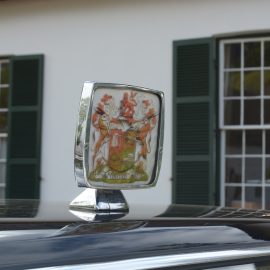
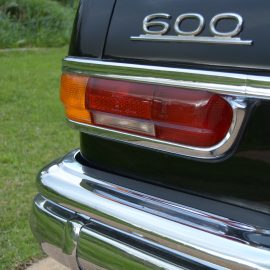
This grandiosely-titled ex-presidential Mercedes-Benz 600 Pullman Landaulet is an imposing vehicle set off by the illuminated emblem on the roof. Why, even the three-pointed-star bonnet ornament is roughly 20 per cent bigger than that fitted to other Mercedes-Benzes of the same era, such was the attention to style and detail.
That’s what you call Über presence for sure…
The vehicle is currently not on display.