


01 Aug The President’s Birthday
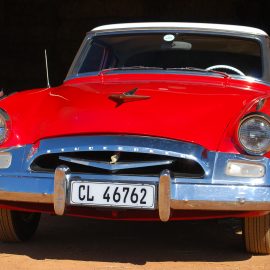
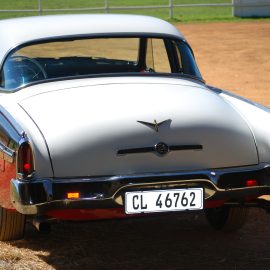
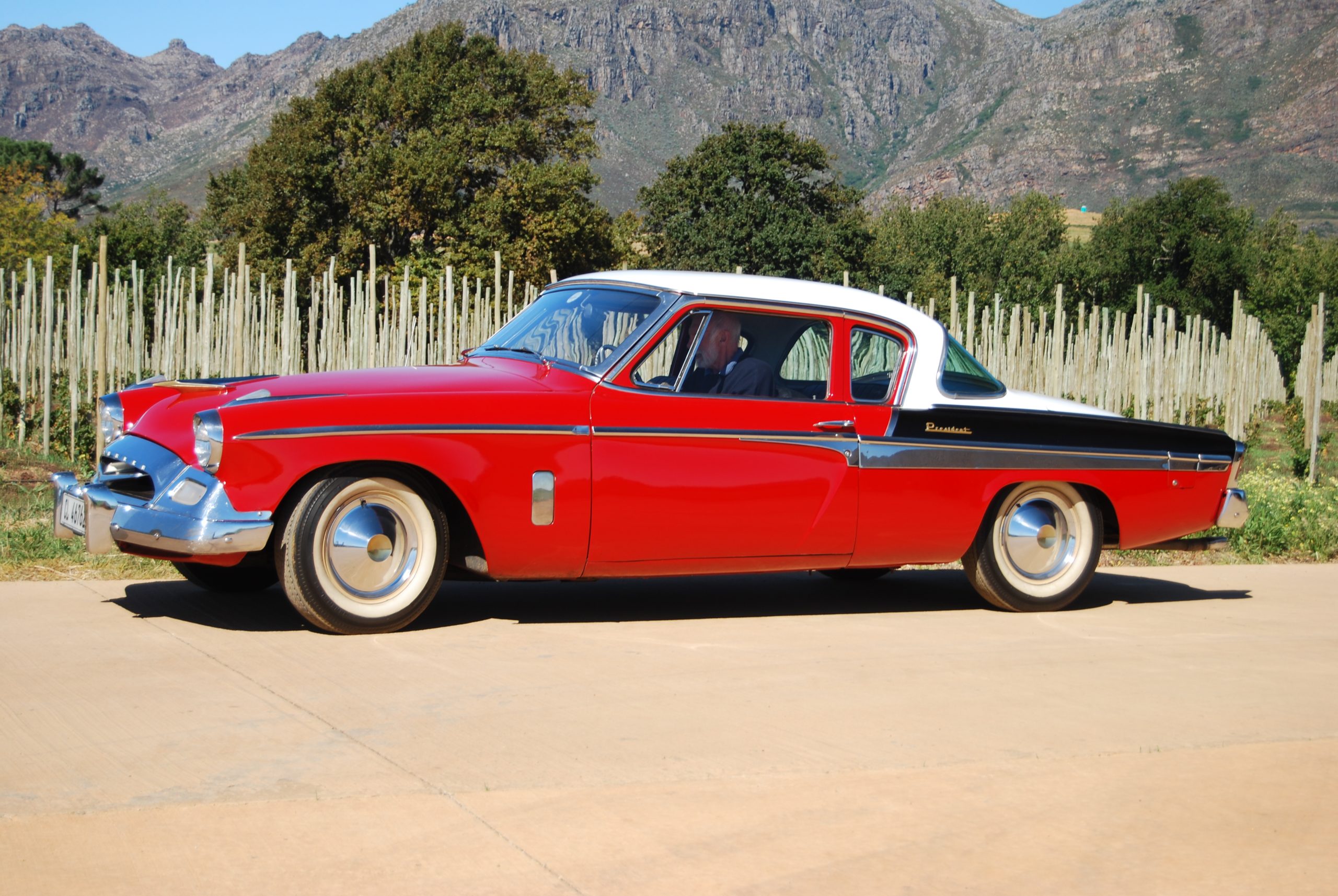
One of the most colourful cars in the FMM collection is celebrating its 70th birthday this year – the 1955 Studebaker President. And like many presidents, it does have quite a history…
In the early post-war years, Studebaker, one of the world’s oldest wagon and automobile manufacturers – it was founded in 1852 – ranked just behind General Motors, Ford and Chrysler in automobile production. At that time, its cars were quite radical and distinctive in design thanks, in the main, to Raymond Loewy, a man considered by many to have been the father of industrial design. Loewy had a long and fruitful association with Studebaker that began in the late 1930s and lasted for more than 20 years. One of the last – and most successful – designs credited to him was a coupé that appeared in 1953 as both a hardtop (K-body) and pillared coupé (C-body), known as the Starliner and Starlight, respectively. That Studebaker saw fit to produce two models that were practically the same – only the side window treatment differed – was perhaps a clear sign that all was not well at South Bend, Indiana…
For in August 1954 Studebaker was in deep trouble as it battled to compete with Detroit’s Big Three, in particular General Motors and Ford who were engaged in a price war. Total model year output of 81 939 units was half that of the previous year and production was stopped. Studebakers were comparatively expensive to build and, as a result, more expensive to buy. The company’s high-paid labour force was seen to be less than dedicated but the unions helped persuade the workers to accept a pay cut to help save their jobs, but that action was not enough. Reluctantly, a merger was proposed, a move that Packard was also contemplating, and so the two quickly agreed to join forces and in the October the Studebaker-Packard Corporation was born – with a year-end balance sheet showing a (before tax credits) loss of nearly $42 million.
Alongside the new-for-’53 Champion and Commander sedans, the K- and C-body coupés were dramatic for the time, the proportions and clean lines taking American auto design into a new era. But there is a twist to this tale – although universally known as the Loewy coupés, the styling was actually handled by one of Loewy’s associates, Robert Bourke, who was assigned full-time to Studebaker. The design was conceived as a show car but management deemed fit to put it into production alongside the sedans, although from a manufacturing perspective the two styles were not compatible. Such irrational thinking was to prove costly, literally and figuratively.
But the aerodynamic coupés were met with almost overwhelming praise, consistently rated as one of the best-designed cars of the 1950s – the Starliner was to be described by the Museum of Modern Art as a ‘work of art’. Long (5,13 metres) and low (1,43 m – the lowest of any domestic vehicle) and riding on a 3,06-metre wheelbase, the fine proportions featured a sloping bonnet, a slim, two-piece horizontal grille, ‘reverse-angle’ styling cues (the rear pillar, door swage line, tail-lights) and a wraparound rear window, all set off by a general lack of ornamentation – bucking the industry trend. Automotive News was later to announce that ‘The 1953 Studebaker, a long-nosed coupé with little trim and an air of motion about it, was acclaimed the top car of all time’.
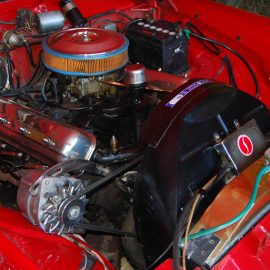
Minor tweaks and upgrades took place leading up to the 1955 model year, for which production started in September 1954 with cars that were essentially carry-overs but with more power, more chrome and brighter colours as an answer to the marketing department’s demands. To help broaden the model line-up’s appeal, an old name was reintroduced – President. From 1926 to 1942, President was the name given to Studebaker’s premier model – the first generation ran from 1926 to 1933, the second from 1934-40 and the third spanned 1941-42. The ’55 President name applied to State and DeLuxe spec four-door sedans as well as the two coupés, both in State spec – the names Starliner and Starlight were dropped – and given a bored-out version of the company’s standard 232ci (3,8-litre) V8. Cubic capacity of this Wildcat motor had been enlarged to 4 247 cc and with a four-barrel carburettor it produced 130 kW, but later in the year this engine was uprated to 138 kW at 4 500 r/min and renamed Passmaster. Dual exhausts were fitted.
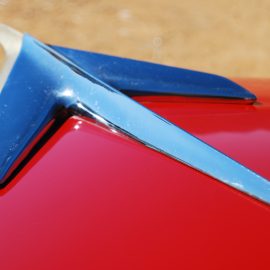
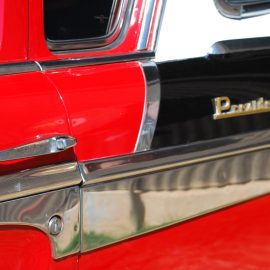
A stylised, part-gold-coloured ‘flying bird’ bonnet ornament and bright front fender trim strips were unique to the President and complemented full-length stainless steel ‘butter knife’ body-side mouldings. A run of 14 fully-equipped President hardtops was built to test customer reaction, the spec including triple-tone paint schemes, a special bonnet ornament, dual exterior mirrors, tail-pipe extensions and reverse lights. Interior upgrades included full instrumentation set in an engine-turned metal-face panel, leather upholstery, a clock and an ‘eight tube’ radio.
Mechanically, it had power brakes, power steering and ran on tubeless whitewall tyres. A favourable response led to the production go-ahead for what was the most fully-equipped standard Studebaker ever built. It was named Speedster, denoted by Speedster badging and chequered flag emblems on the sides. A road test by Motor Life realised a 0-60 mph (96 km/h) time of 10 seconds flat and a top speed of 176 km/h. The test stated the brakes are “good enough for competition purposes”. It was only built for a year.
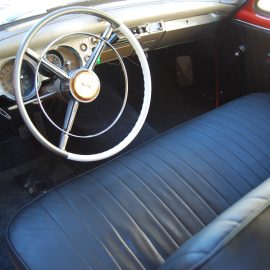
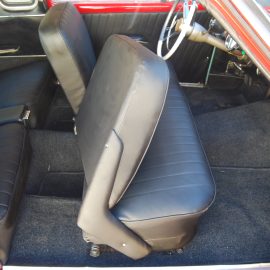
At first glance, the FMM’s C-body President could be mistaken for a Speedster model due to its red/white/black colour scheme but other details show it is a standard model. It certainly catches the eye and sliding onto the split-backrest (to ease entry/exit) bench front seat creates a keen sense of anticipation. Firing-up the V8 creates an honest-to-goodness American V8 rumble. The gearbox is a column-shift three-speed manual that engages without fuss. It pulls away and gets up to speed with no effort and proves surprisingly easy to drive. Despite assistance, the steering is low-geared so the large two-tone wheel requires plenty of twirling especially in confined spaces – the turning circle is large due to the long wheelbase – but it is light in operation. There is torque aplenty from the gruff motor and the brakes do pull up firm and true without any muscle-challenging activation.
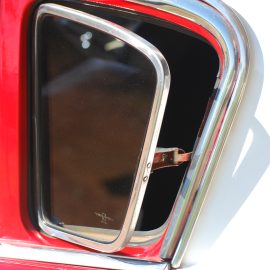
For such a long car, the cabin is quite short but with some cooperation from the front passengers, rear room is reasonable despite the large transmission tunnel. There is no frame to the front quarter-lights and the rear windows clip open, so ventilation is not a problem – but it does beggar the question why build this AND a pillarless version…
In what was a record sales year for the American auto industry, Studebaker’s 1955 model year production rose to 133 827 units (including 34 621 K- and C-bodies), an increase of 63% over the previous year’s total. Apart from Loewy’s lightweight 1963 Avanti, these were the last true Studebakers. With the Studebaker-Packard relationship up to speed, for 1956 the sedans were completely redesigned and the coupés facelifted front and rear and renamed Hawks. Reviving the President was a short-lived final hurrah to one of auto history’s founding companies. At least it bowed out in style.
Watch out for the Studebaker in the September display change – more details to follow in the next news brief.