


04 Feb E FOR ETERNITY
Mike Monk drives an iconic sports car built just up the road from where he was born that set a global standard for sports cars…
In the post-war period, Coventry was the epicentre of the British Motor Industry with numerous factories spread around the midlands city. Jaguar Cars’ factory was situated in Browns Lane, which was approximately 7 km ‘up the road’ from the Alvis factory – I was born roughly half way between the two and grew up seeing many of their products first hand. Jaguars always impressed and I developed a long-standing admiration for the brand. Over the years in my motoring journalism career I have driven a number of ‘Coventry Cats’ and I recently renewed acquaintance with one of the company’s most iconic models, the legendary E-Type.
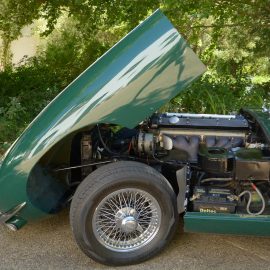
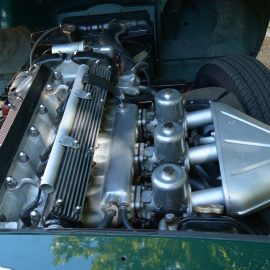
Based on Jaguar’s triple Le Mans-winning D-Type, the E-Type (badged XK-E in America) was manufactured from 1961 to 1974. Introduced as a rear-wheel-drive grand tourer in two-seater coupé and convertible form, its sleek appearance, advanced technologies, high performance and competitive pricing set a new benchmark in the automotive world. It featured a largely unitary body construction with a front subframe carrying the engine, suspension front bodywork bolted directly to the body tub. The whole one-piece front end hinges forward to expose the complete powertrain.
Other design highlights included front and rear independent suspension, power-assisted disc brakes (mounted inboard at the rear), and rack-and-pinion steering, which was quite radical at the time. With a claimed top speed of 240 km/h and a sub-7-second 0-60 mph (97 km/h) acceleration time, it set a new standard for mass-production sports cars.
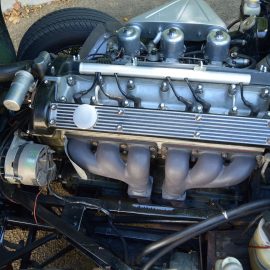
As was common at the time, ongoing improvements to the car’s specification were made that, in time, led to various eras being identified, with the first, naturally, being designated Series 1. These cars were fitted with a 3,8-litre version of Jaguar’s already famed XK six-cylinder engine. In 1965 the motor was stretched to 4,2 litres and mated with a now fully-synchromesh gearbox. Other improvements included a switch to negative earth electrics involving replacing the dynamo with an alternator, and the fitment of reclining seats.
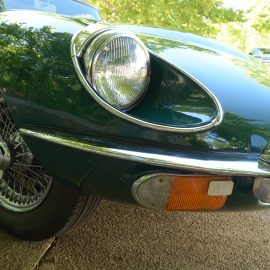
Following the Series 1 there was a transitional series of cars built in 1967-68 as model year 1968 cars, unofficially called Series 1½. Twin cooling fans to overcome heating problems, and adjustable seat backs were fitted. Due to American ‘safety measure’ pressure, the headlight cowls were removed and, inside, black rocker switches replaced the original toggle switches. Engine power was reduced for the American XK-E to meet that country’s new emissions standards. The winged knock-off wheel nut was also outlawed.
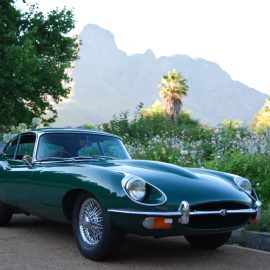
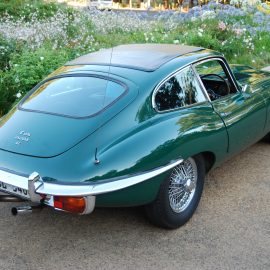
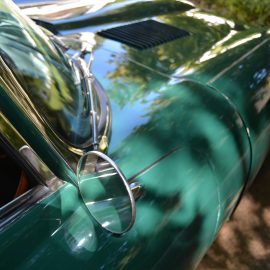
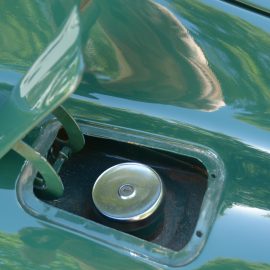
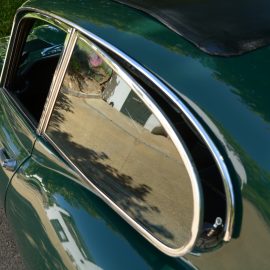
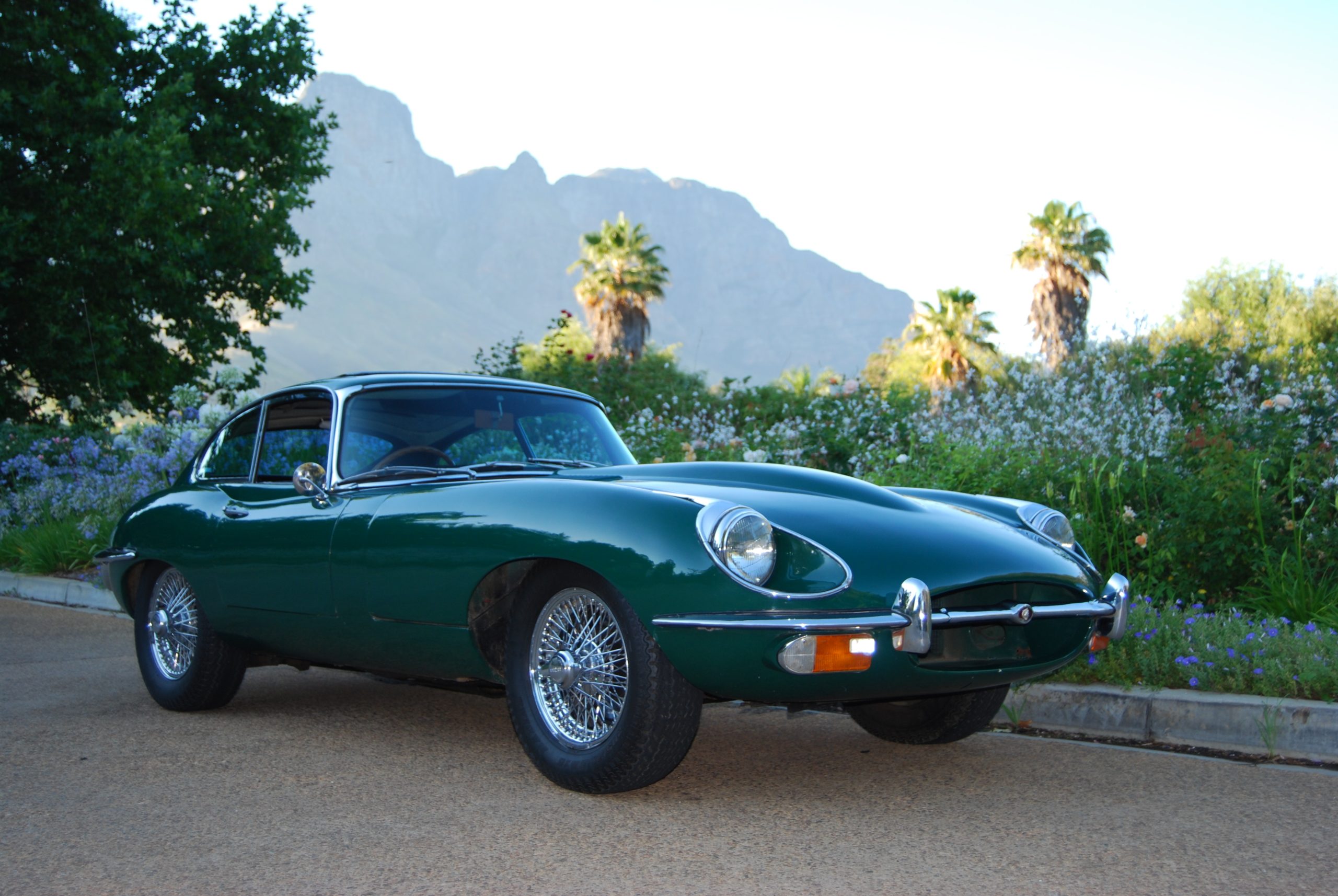
FMM’s 1968 fixed-head coupé – appropriately painted in a shade of British Racing Green – is one of the rare ‘transitional’ Series 1½ models and is still in good shape despite its near six decade existence. The long nose/short rump design – typical of the breed – was often described as ‘phallic’ to emphasise the macho image of a sports car. Long and low, it’s actually not easy to get in and out of, especially for tall or long-legged individuals. Although the doors are front-hinged well forward, the actual gap to enter between the windscreen and B-pillar is narrow. The sills are very deep so it’s a case of head down, step in and drop down into the firm seat. Quite how fashionable ladies would manage in a dignified manner escapes me…
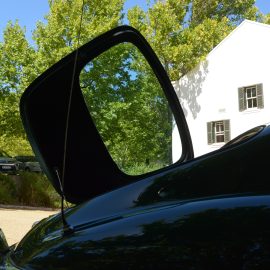
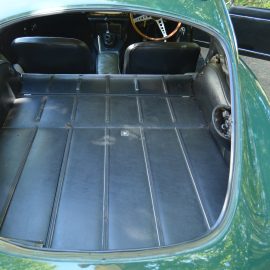
The side-hinged tail door opens up to reveal a flat but shallow luggage floor, due to the suspension layout underneath. A narrow folding screen is fitted to help prevent any items sliding forward. The spare wheel is housed beneath the floor.
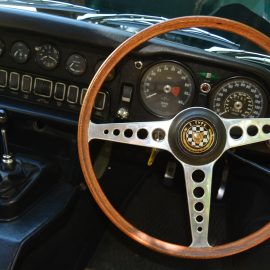
But once seated the E-Type already feels the part. Firing up, the XK engine sounds the business. Initiated by Jaguar founder Sir William Lyons, it was designed during WWII by a team led by Chief Engineer Bill Heynes along with Walter Hassan, Claude Baily and Harry Weslake (who specialised in cylinder head design). In 4 235 cc guise and fed by triple SU carburettors, it delivers 198 kW at 5 400 r/min and 384 N.m of torque at 4 000. The thinly wood-rimmed steering wheel with drilled aluminium spokes is large and the four-speed gear lever sits atop a small console, comfortably close to hand. The pedals are close set, so sneakers off to avoid any double depressions. No detached touch screen control here: the dashboard is awash with full instrumentation and an array of switchgear that is a tangible delight.
On the move the E-Type conveys all the classic period sports car traits of performance, noise, response, ride and handling. It soon becomes clear why the E-Type made such an impression in its day. It was relatively advanced and offered outstanding performance – at an affordable price. The year after it was launched, the Ferrari GTO appeared that was similar in concept but far more expensive.
Series 2 E-Types were built from 1968-1971 and were essentially tweaked versions of the earlier model designed to appease the American market, which was Jaguar’s prime export target of the time. Air conditioning and power steering were available as factory options. The E-Type Series 3 was introduced in 1971, with a new 5,3-litre Jaguar V12 engine, uprated brakes and standard power steering. An automatic transmission, wire wheels and air conditioning were available options.
The E-Type bowed out in 1974 by which time it had become a legend in motoring history. Along the way, some slight design differences and an increased wheelbase to essentially allow for the introduction of a 2+2 Coupé took place, but the purpose of the E-Type was never lost – affordable performance motoring.
FMM’s 1968 Jaguar E-Type Series 1½ is currently on display in Hall C.